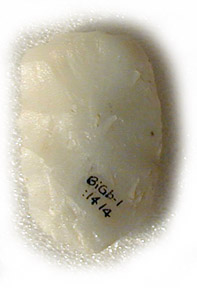
During the Archaic Period, local stone was used to make tools, but some was also obtained from distant sources through trade. The tradition of trade continued during the Woodland Period, and new exchange networks were added.
Kitchisipi chert, one of the principal local stones used, is found at the mouth of the Gatineau River (location 5). Onondaga chert, a chipping stone, was quarried at the western end of Lake Ontario (location 4). Other types of stone from regions farther north were acquired through trade. Fine cherts from the Hudson Bay Lowlands (location 1) have been identified, as well as pure white quartzite from a well-known source in central Quebec at Mistassini Lake (location 3). Artifacts discovered near the mouth of the Gatineau River also suggest that trade networks extended as far as the northern tip of Labrador (location 2).